

The Rim Joist: The Biggest Air Leak in Most Canadian Basements
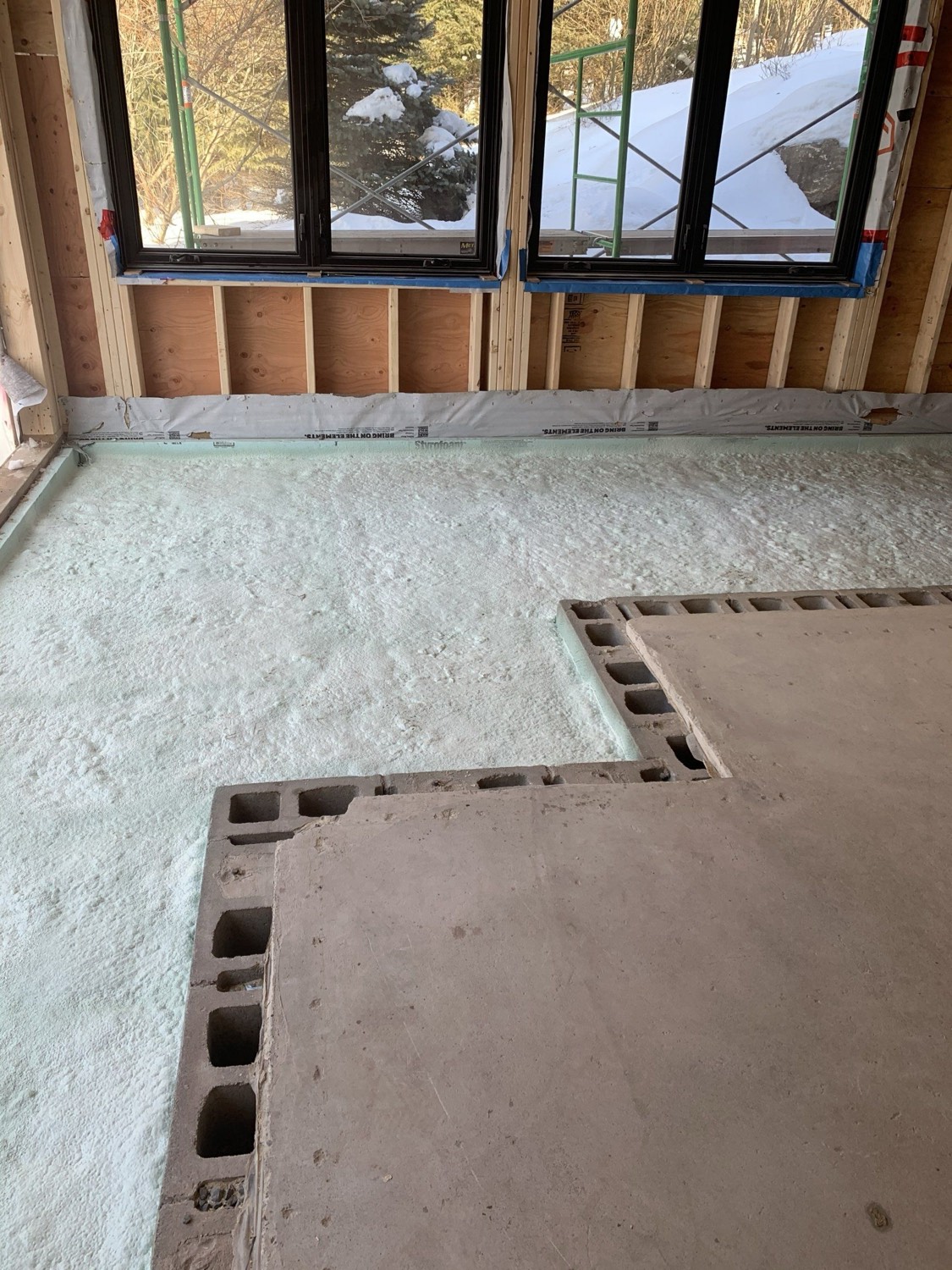
It is a strip of wood about ten inches tall running around the entire perimeter of your house, and in most homes it is doing almost nothing to keep the cold out.
Go down to your basement and look up where the concrete wall stops and the wooden floor structure begins. That band of wood running around the entire perimeter — the rim joist, sometimes called the band joist or header — is the single leakiest part of a typical Canadian house.
It is also one of the cheapest things to fix properly, and one of the few insulation upgrades where you can genuinely feel the difference the same week.
Why this one strip of wood matters so much
The rim joist sits at the exact point where three different building assemblies meet: the foundation wall, the floor system and the exterior wall above. Everywhere materials meet, there are seams. Here you have the joint between concrete and sill plate, the sill plate to rim joist, the rim joist to subfloor, and a joist bay every sixteen inches, each with its own gaps at the top and bottom.
Then add the penetrations. Dryer vents, hose bibs, gas lines, electrical service, air conditioning line sets and bath fan ducts almost all leave the building through this band. Each one is a hole cut through the envelope, and most were never sealed with anything more than the drill bit that made them.
What is usually in there — and why it fails
In most homes we open up, the rim joist bays have a scrap of fibreglass batt pushed into each one. Sometimes it has a paper facing. Sometimes it has fallen out entirely and is sitting on the floor below.
The problem is not that fibreglass is a bad product. It is that fibreglass does not stop air, and this is a location defined by air movement. Cold outdoor air passes straight through the batt, washes the back of it, and carries away the heat the batt was supposed to be holding. The insulation is technically present and functionally absent.
Worse, there is a moisture consequence. Warm, humid indoor air reaches the cold rim joist behind that batt, and when it hits the dew point it condenses on the wood. That is how you end up with damp, black-stained rim joists and mould behind insulation that looked fine from the basement.
Why spray foam is the right tool here specifically
We do not recommend foam for every square foot of every house. At the rim joist we recommend it almost every time, for four reasons:
- It seals as it insulates. The foam expands into the seams between the sill plate, the rim joist and the subfloor — the exact places where the air is moving.
- It fits the geometry. Every bay is a slightly different size, with wiring and pipes running through it. Foam fills what is actually there.
- It controls vapour. At normal installed thickness, closed-cell foam keeps humid indoor air away from the cold wood, so condensation never gets the chance to form.
- It stays put. Foam is bonded to the wood. It cannot fall out of the bay in five years the way a friction-fit scrap does.
What you will notice afterwards
Rim joist work is the upgrade customers describe in terms of comfort rather than numbers. The basement stops feeling like a cellar. The floor above it — usually a living room or a kitchen — stops being the cold room in the house. Drafts along the baseboards on the exterior walls quieten down, because a good part of that air was coming in below and travelling up inside the wall cavities.
It also changes how the rest of the house behaves. Reducing the air coming in at the bottom reduces the air leaving at the top, which takes load off the attic and reduces the moisture being pushed up there all winter.
Doing it as part of a bigger job
Rim joists are a small area, so on their own they are a small job. Most of our customers have us do the rim joists at the same time as a basement renovation, a crawl space, or an attic upgrade, because the mobilisation is already paid for and the crew is already on site.
If you are finishing your basement, do this before the framing goes up. Once there is a stud wall and drywall in front of the rim joist, the cost of getting back to it multiplies.
If you are not sure what is in your rim joist bays right now, look. A flashlight and five minutes will tell you whether you have a problem worth quoting.
Questions about your own building? Call (705) 812-1955 or request a free quote — we serve Barrie, Simcoe County & the Kawartha Lakes area.