

Spray Foam vs. Blown-In vs. Batt: Choosing in a Simcoe County Home
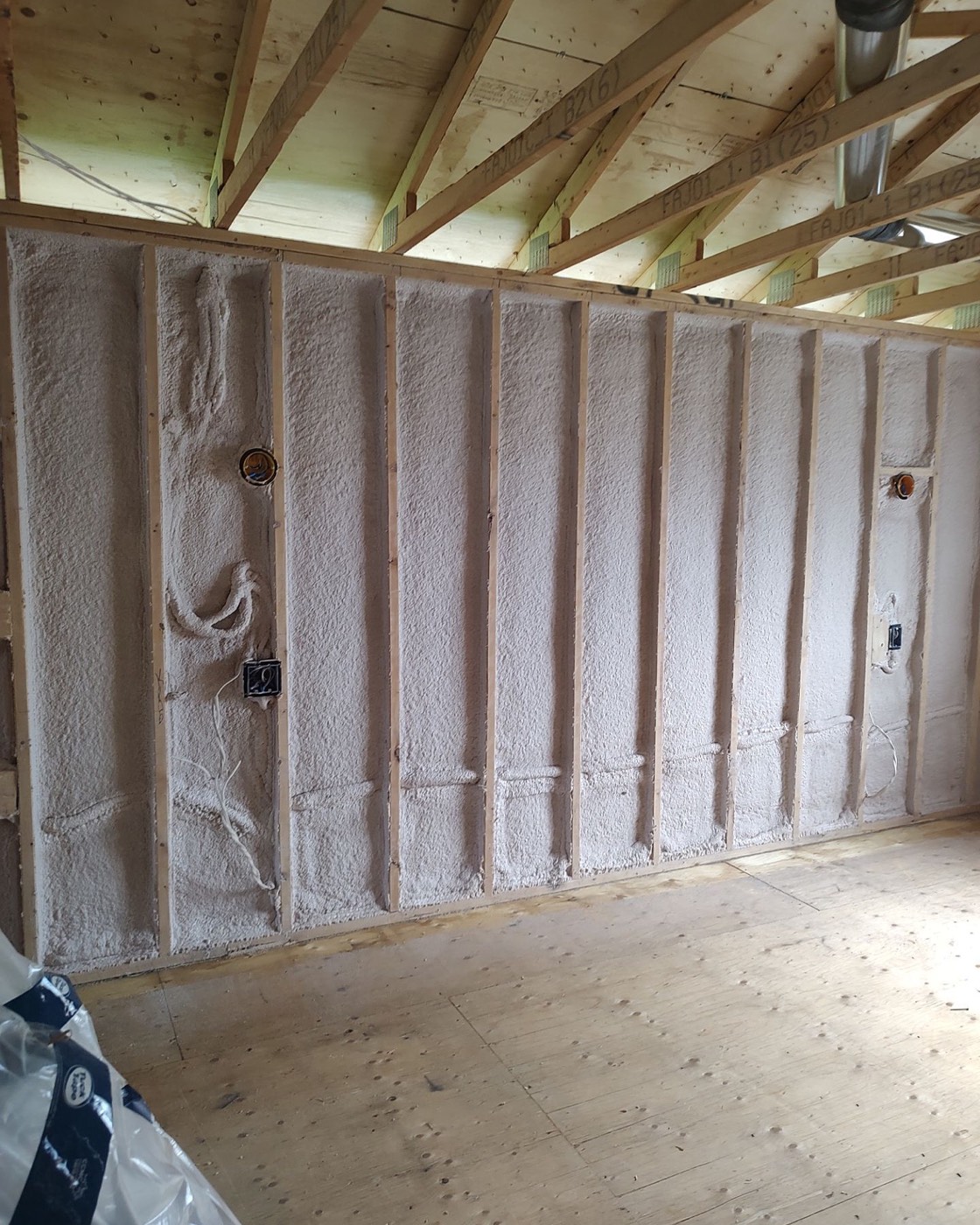
Three products, three different jobs. A straight comparison of where each one wins — and where paying for the expensive option is a waste of money.
Most people call us having already decided what they want, usually based on something a neighbour did. That is a fine place to start, but the right product depends far more on the assembly than on the budget.
Start with the question the product has to answer
Every insulation decision comes down to which of these you actually need: fill a cavity, stop air, control moisture, or get maximum R-value into limited depth. Each product answers a different combination.
Closed-cell spray foam
Foam is insulation, air barrier and vapour retarder in one application, at roughly R-6 per inch. It bonds to the substrate, never settles and fills irregular geometry completely.
- Where it wins: rim joists, crawl spaces, cathedral and vaulted ceilings, attic roof decks, cantilevers, bonus rooms over garages, retrofits with no depth to spare, and any assembly where moisture is a concern.
- Where it is overkill: large, open, standard, dry wall and attic areas where a cheaper product will hit the same code number.
- Must know: it needs certified applicators under CAN/ULC-S705.2, a re-entry period during install, and a code-required thermal barrier over it in occupied spaces.
BIBS blown-in
Loose fibre blown behind netting until the cavity is packed to density. It flows around wiring, boxes, pipes and bracing instead of being cut around them — R-24 in a 2x6 wall, R-14 in a 2x4.
- Where it wins: new-build walls, attic top-ups, sound control between rooms and floors, and finished walls that can be upgraded through drill-and-fill without gutting the house.
- Where it falls short: it does not air seal and it is not a vapour retarder — so it belongs in assemblies where those are handled separately.
- Must know: performance depends on being blown to density, not just filled.
Batt
The economical standard for open, clean, standard-width framing. Fibreglass for value, mineral wool where fire resistance and sound matter more.
- Where it wins: new-build walls and ceilings, interior sound partitions, basement stud walls, and anywhere budget is the binding constraint.
- Where it falls short: awkward cavities, anything requiring an air or vapour barrier, and jobs where the crew is rushed — batt is the product most damaged by careless installation.
- Must know: the rating assumes a complete, uncompressed, correctly cut fit. That is the whole game with batts.
What most houses actually end up with
A combination. It is very common to foam the rim joists and the crawl space, blow the attic to full depth, and batt the open new framing — because that is the cheapest way to get the best real-world result. A contractor who recommends the same product for every square foot of your house is selling from a truck, not solving a building problem.
How we actually decide, walking through a house
There is no product-first answer. On an assessment we are asking the same four questions in every space, and the answers pick the product:
- Is air moving through here? Rim joists, attic bypasses, crawl spaces and cathedral ceilings almost always say yes, and that points to foam.
- How much depth do I have? A shallow cavity that still has to hit a number needs R-value per inch.
- Is moisture a factor? Anywhere warm indoor air can reach a cold surface needs vapour control designed in, not added later.
- Is the cavity open, standard and dry? If yes, the cheaper products do the same job and the money is better spent elsewhere.
What a real quote usually looks like
Take a typical two-storey with an unfinished basement — a very common Barrie-area file. The recommendation almost never comes back as one product:
- Rim joists: closed-cell foam. Small area, biggest air-leak return in the house.
- Attic: air seal the bypasses first, then blow to a current, even depth. Removal first if what is up there is wet or contaminated.
- Open new framing: batt or BIBS depending on budget and whether sound matters.
- Cathedral ceiling or bonus room over the garage: foam, because nothing else fits the depth.
- Interior partitions: blown or mineral wool where quiet is worth paying for.
Priced that way, the expensive product goes where it earns its cost and the economical product covers the large areas. That is usually a lower total than foaming everything and a far better result than batting everything.
Questions about your own building? Call (705) 812-1955 or request a free quote — we serve Barrie, Simcoe County & the Kawartha Lakes area.