

Soundproofing Between Rooms: What Actually Works, and What Is a Waste of Money
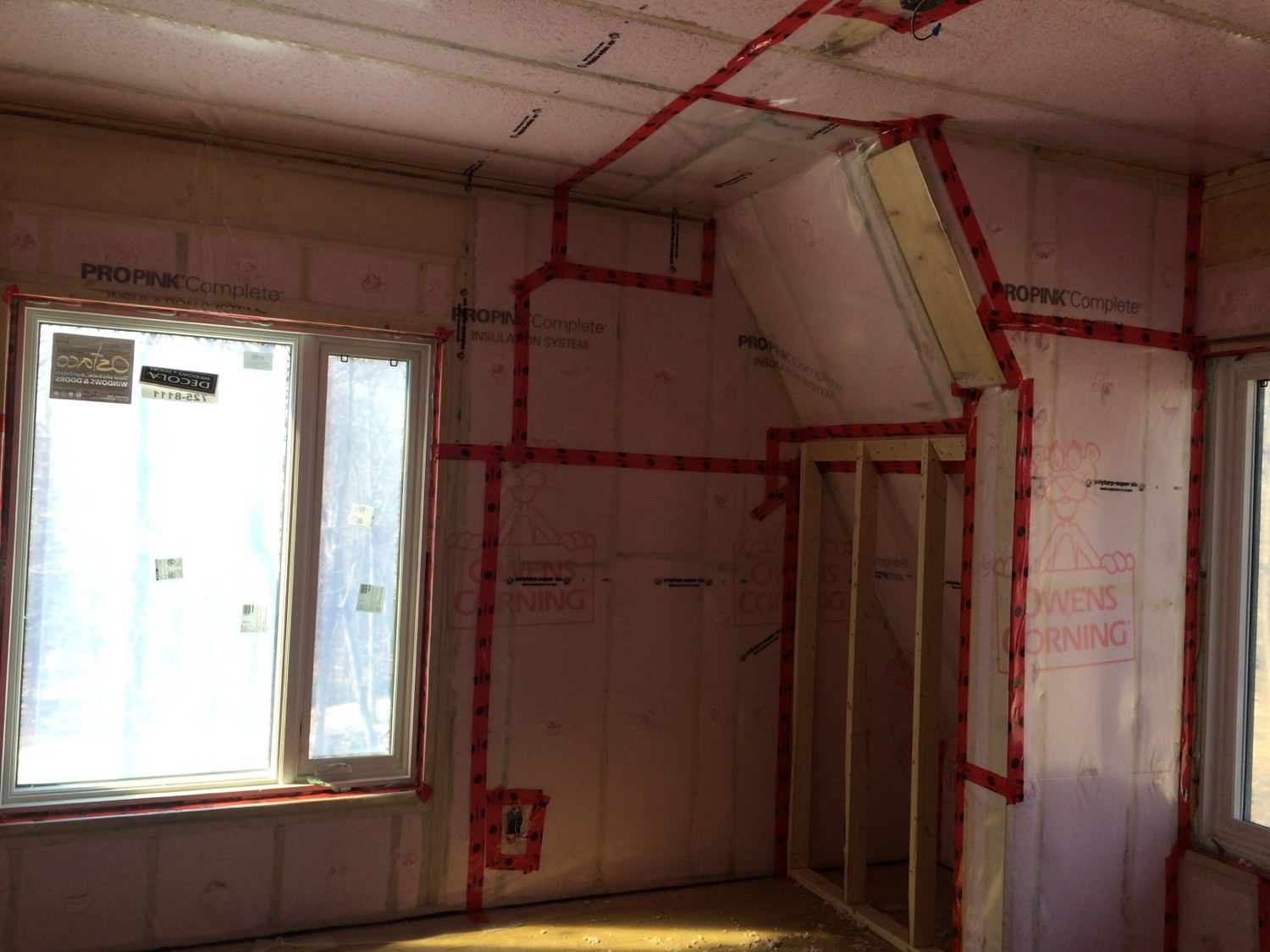
Insulation in an interior wall is the cheapest sound upgrade there is — and on its own it will not fix a room where you can hear a conversation through the door.
Sound complaints come in a predictable order. A home office beside a living room. A bedroom against a bathroom. A media room under a bedroom. A teenager's drum kit anywhere at all.
Insulation is a real part of the answer, and it is by far the cheapest part. It is also not the whole answer, and any contractor who tells you a wall full of fibre will make a room silent is setting you up to be disappointed.
How sound gets from one room to another
Airborne sound — voices, television, music — travels as pressure waves that make the drywall on one side of a wall vibrate. That vibration passes through the cavity and out of the drywall on the other side. Anything that absorbs energy in that cavity reduces how much makes it across.
An empty stud cavity is the worst case, because it behaves like a drum: air in the cavity couples the two drywall surfaces directly, and can even resonate at certain frequencies. Filling it changes that completely.
What STC numbers mean in practice
Sound Transmission Class is a single-number rating for how much airborne sound an assembly stops. The scale is not linear and the practical meaning is easier to remember than the maths:
- STC 30–35 — an uninsulated interior wall. Normal speech is audible and often intelligible.
- STC 40 — loud speech is audible but generally not intelligible.
- STC 45–50 — loud speech is a murmur; most normal household noise stops being a problem.
- STC 55+ — approaching what you would specify for a home theatre or a shared party wall.
Blown-in fibreglass injected into a standard 2x4 interior wall reaches an STC of 50. That is a genuinely large jump from an empty cavity, and it is achieved without changing the framing, the drywall or the room dimensions.
Why blown-in beats batts for sound specifically
For thermal performance, a well-installed batt and a blown cavity end up in similar territory. For sound, density and completeness matter more, and that is where blown-in pulls ahead.
- The cavity is packed to a specified density rather than loosely filled, and denser fibre absorbs more energy.
- It flows around wiring, boxes and bracing instead of being cut around them, so there are no small open channels left.
- It does not sag over time, so the top of the wall does not quietly become an air gap in ten years.
Where mineral wool batts are specified, they perform very well acoustically too — denser than standard fibreglass batts and excellent in floor systems. We install either; the choice usually comes down to whether the cavity is open.
Floors between storeys are a different problem
Between floors you are dealing with two kinds of noise. Airborne sound — voices and television — behaves much like it does in a wall, and filling the joist cavity helps a great deal.
Impact sound — footsteps, dropped objects, chair legs — is structural. The energy goes directly into the floor structure, and insulation in the cavity only does part of the work. Reducing impact noise properly also involves what is on top of the floor and how the ceiling below is attached.
Filling the joist bays is still worth doing, and while the product is going in it also gets around plumbing lines, vents and heating ducts — which quietens the whistles and rushes that come from mechanical runs, and stops heating and cooling loss in the same pass.
The flanking paths that undo everything
This is the part that decides whether the job feels successful. Sound follows air, and it will take any route around your beautiful new wall:
- The door. A hollow-core door with a gap under it is the weakest link in almost every room. No wall upgrade beats fixing the door.
- Electrical boxes back to back in the same stud cavity — offset them and the wall improves measurably.
- Shared ductwork. A supply run connecting two rooms carries conversation between them beautifully.
- The ceiling plane — sound going up over the wall through a shared attic or joist space.
- Gaps at the top and bottom plates, and around any penetration.
Where to spend first
If you are building or renovating, insulate the interior partitions while the walls are open. It is inexpensive at that stage and impossible to do cheaply later.
If the walls are already finished, drill-and-fill lets us inject the cavity without gutting the room, which makes retrofit soundproofing practical in an existing home. It is the same process we use for thermal upgrades on older houses.
Tell us what you are actually trying to stop hearing, and from where. The answer for a nursery is not the answer for a drum room, and we would rather scope it properly than sell you the same wall twice.
Questions about your own building? Call (705) 812-1955 or request a free quote — we serve Barrie, Simcoe County & the Kawartha Lakes area.